

Type 3057
Read More


As turbine architectures become more efficient, lightweight, and thermally stressed, the need to validate performance under rapidly changing thermal and dynamic environments has never been greater. Modern gas‑turbine test campaigns must capture high‑temperature vibration, pressure pulsations, and dynamic structural behaviour in real time to ensure engine reliability and durability.
These measurements support critical activities such as blade dynamics validation, bearing and rotor assessment, and the development of Health and Usage Monitoring Systems (HUMS) and condition‑based maintenance strategies - while operating within tight test schedules and highly instrumented facilities.
HBK’s gas‑turbine test systems integrate seamlessly with high‑temperature sensing technologies - including accelerometers, pressure sensors, and strain instrumentation -and provide a robust framework for synchronized data acquisition, real‑time validation, and advanced post‑analysis across the full engine operating envelope.
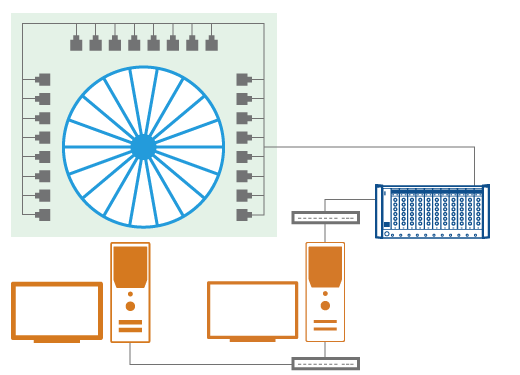
This LAN XI based system provides reliable data recording for hundreds of dynamic channels, highly detailed real time monitoring, and efficient sharing of test data for post test analysis. Integrated real time analysis and alarm functions help ensure data validity, even in high temperature environments where vibration characteristics, pressure behaviour, and strain responses can shift rapidly.
Highly scalable and easily transportable, the system can be configured as a high capacity centralized data acquisition platform or distributed into smaller mobile systems. Its modular architecture supports engine stand testing, subsystem validation, and distributed measurement campaigns supporting HUMS and condition monitoring development.
BK Connect software provides powerful post analysis capabilities, supporting a wide range of native and third party data formats. Engineers can correlate high temperature vibration, pressure, and strain measurements with operating conditions to gain a comprehensive understanding of turbine structural and dynamic health.
High-temperature vibration data enables validation of blade dynamic response, bearing condition, and rotor balance, while providing insight into thermally induced changes in structural vibration response.
HBK data‑acquisition platforms integrate seamlessly with high‑temperature accelerometers and pressure sensors, enabling stable measurement performance despite rapid thermal transitions.
Yes. HBK solutions acquire, synchronize, and analyse the vibration and pressure signatures required to design and validate HUMS algorithms.
Extreme heat can alter material properties and create thermal shocks, impacting signal stability. HBK systems ensure reliable data capture through robust DAQ hardware and real‑time validation.


This will bring together HBM, Brüel & Kjær, nCode, ReliaSoft, and Discom brands, helping you innovate faster for a cleaner, healthier, and more productive world.

This will bring together HBM, Brüel & Kjær, nCode, ReliaSoft, and Discom brands, helping you innovate faster for a cleaner, healthier, and more productive world.

This will bring together HBM, Brüel & Kjær, nCode, ReliaSoft, and Discom brands, helping you innovate faster for a cleaner, healthier, and more productive world.

This will bring together HBM, Brüel & Kjær, nCode, ReliaSoft, and Discom brands, helping you innovate faster for a cleaner, healthier, and more productive world.

This will bring together HBM, Brüel & Kjær, nCode, ReliaSoft, and Discom brands, helping you innovate faster for a cleaner, healthier, and more productive world.

This will bring together HBM, Brüel & Kjær, nCode, ReliaSoft, MicroStrain and Discom brands, helping you innovate faster for a cleaner, healthier, and more productive world.