



Operational Modal Analysis - 8760, 8761, 8762
Read More

In Operational Modal Analysis (OMA), only the output of a structure is measured using the natural ambient and operating forces as unmeasured input.
Many civil engineering and mechanical structures are difficult to excite artificially due to their physical size, shape or location. Civil engineering structures are also loaded by ambient forces such as the waves against offshore structures, the wind on buildings, and traffic on bridges, while mechanical structures such as aircraft, vehicles, ships and machinery exhibit self-generated vibration during operation.
This makes it important that measurement methods minimally influence the structure’s response, particularly for smaller components where added mass can shift natural frequencies.
In Operational Modal Analysis, these forces, which would produce erroneous results in classical modal analysis, are instead harnessed as input forces. As Operational Modal Analysis can be performed in situ during normal operation, setup time is reduced, and downtime can be eliminated.
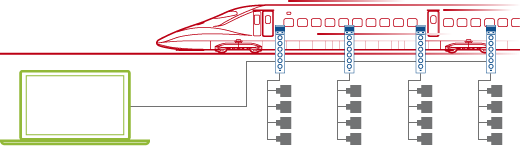
For an integrated, easy-to-use modal test and analysis system, use BK Connect® Time Data Recorder for geometry-guided data acquisition, and then transfer data to PULSE Operational Modal Analysis software for analysis and validation.
To achieve the optimal OMA results, engineers can work with an integrated measurement and analysis chain – combining data acquisition hardware, response sensors and post-processing software ensuring approaches that accommodate the different response characteristics of small, medium, and large structures.
Structural size directly affects frequency content, response amplitude, and how measurement strategies must be applied in Operational Modal Analysis.
Structural size and design play a significant role in OMA. Small components may be sensitive to added mass, while large structures often exhibit low-frequency, low-amplitude vibration, requiring higher sensitivity in measurement setups. Understanding these characteristics helps ensure accurate responseonly data under real operating conditions.
Operational vibration levels vary greatly depending on the structure: smaller components often exhibit higher‑frequency responses that demand minimal measurement influence, while large structures tend to produce lower‑frequency, low‑amplitude motion that requires high sensitivity to capture accurately. Recognizing these differences ensures that the OMA setup captures meaningful modal behaviour under real‑world forces.
OMA is designed to work with natural ambient or operational forces, eliminating the need for hammer or shaker excitation. Controlled excitation becomes relevant only when comparing against classical modal testing methods or when evaluating which test methodology best suits the structure or environment.
Applying structure‑specific principles—such as reducing measurement influence on small structures, ensuring adequate frequency bandwidth, and using sensitive response‑capture approaches for low‑amplitude vibration—helps improve the clarity of response‑only data used in BK Connect® and PULSE OMA workflows. This supports accurate extraction of natural frequencies, damping ratios, and mode shapes.


This will bring together HBM, Brüel & Kjær, nCode, ReliaSoft, and Discom brands, helping you innovate faster for a cleaner, healthier, and more productive world.

This will bring together HBM, Brüel & Kjær, nCode, ReliaSoft, and Discom brands, helping you innovate faster for a cleaner, healthier, and more productive world.

This will bring together HBM, Brüel & Kjær, nCode, ReliaSoft, and Discom brands, helping you innovate faster for a cleaner, healthier, and more productive world.

This will bring together HBM, Brüel & Kjær, nCode, ReliaSoft, and Discom brands, helping you innovate faster for a cleaner, healthier, and more productive world.

This will bring together HBM, Brüel & Kjær, nCode, ReliaSoft, and Discom brands, helping you innovate faster for a cleaner, healthier, and more productive world.

This will bring together HBM, Brüel & Kjær, nCode, ReliaSoft, MicroStrain and Discom brands, helping you innovate faster for a cleaner, healthier, and more productive world.